Configuration
Everything a brewery sets once (and adjusts rarely) lives on one page: Configuration. Each card saves independently.
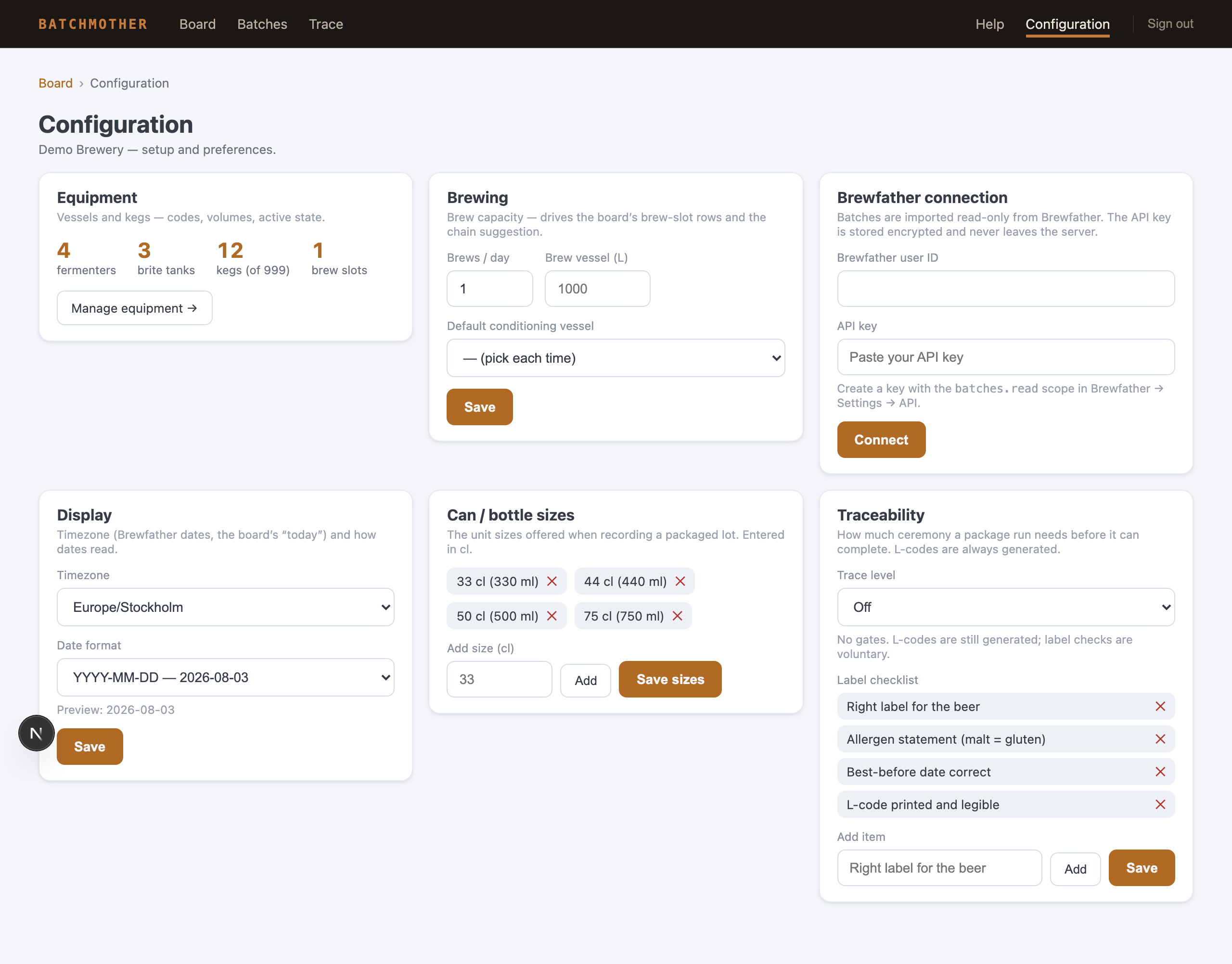
Brewing
Your brewing capacity, described honestly:
- Brews / day — how many turns you can run in one day. This is the number of Turn rows on the board: most small breweries run 1.
- Brew vessel (L) — one vessel, run repeatedly. Batchmother uses it to suggest how many turns a batch needs (batch volume ÷ vessel volume).
- Default conditioning vessel — which vessel type the chain suggestion pre-picks for conditioning: a brite tank, a keg (freeing the fermenter), or the fermenter itself. Leave it blank to choose every time.
Saving reconciles the Turn rows on the board automatically.
Display
Timezone (how Brewfather's timestamps resolve to calendar days, and where "today" falls) and the date format used everywhere dates are shown.
Brewfather connection
Your Brewfather user id and an API key with the batches.read scope. The
integration is read-only — Batchmother pulls batch facts and never writes
back — and the key is stored encrypted and never leaves the server.
Re-importing a batch refreshes recipe facts only; your planning (chains,
statuses, board visibility) is never touched.
Can / bottle sizes
The unit sizes your brewery packages in, entered in centilitres. They become the size options when recording a lot, and drive the suggested quantity from the batch's remaining litres.
Traceability
The trace level ladder — Off, Attest, Checklist — and your label checklist. The seeded checklist is the HACCP core: right label for the beer, allergen statement (malt = gluten), best-before correct, L-code legible. Make it yours — but Checklist mode requires at least one item, and completed runs keep a frozen snapshot of the items they were actually checked against, so editing the list never rewrites history. The full story of what each level demands is in Trace & recall.
Equipment
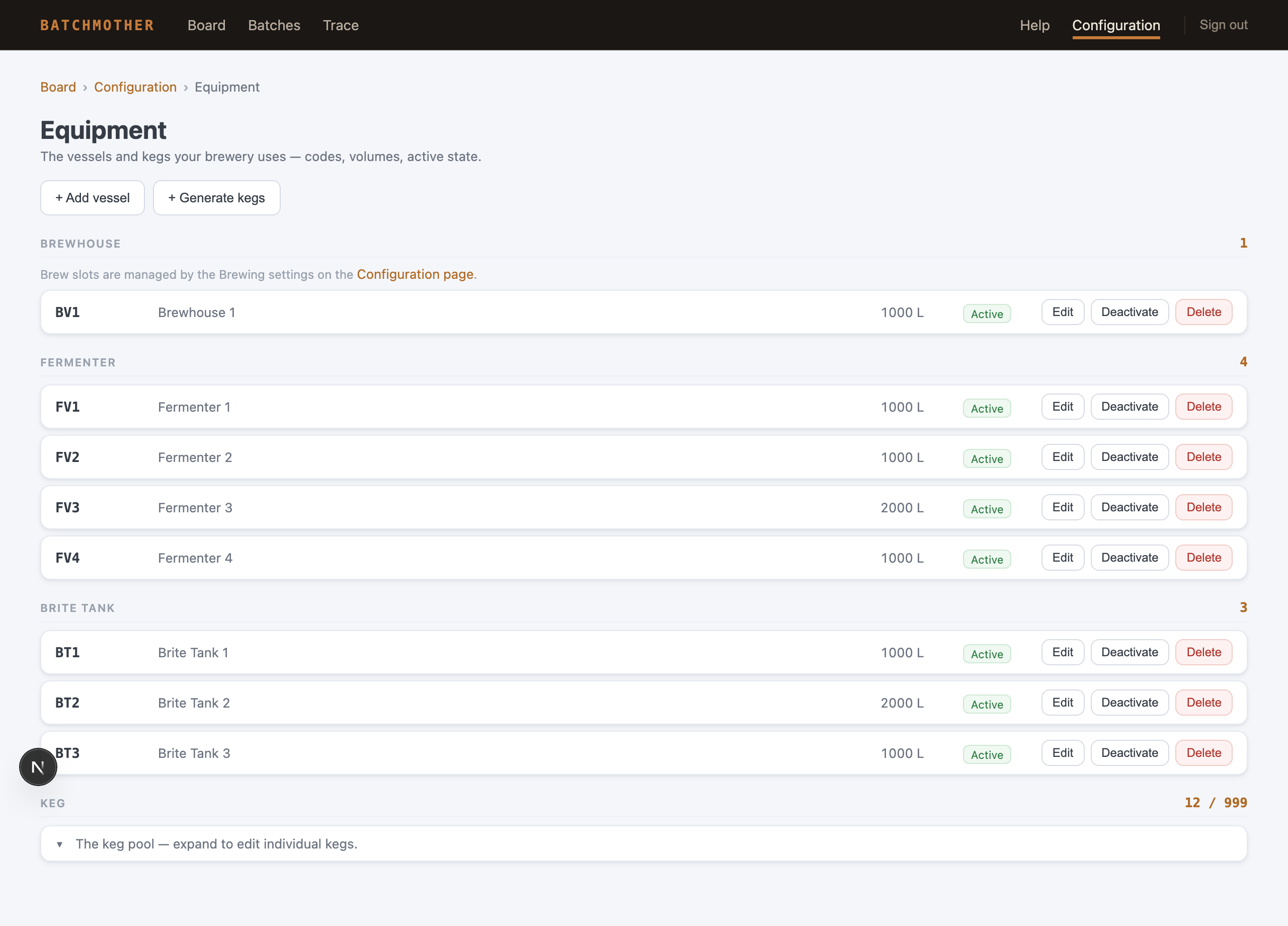
The one setup area big enough for its own page: your vessels and kegs.
- Types — fermenters, brite tanks, and kegs (brew capacity is the Brewing card's job, not a vessel here).
- Working volume is a range — a fermenter or brite tank has a min and a max; a batch fits when its volume lands between them. Too little ferments badly, too much has no headspace — so "does it fit?" is a real answer, not a hope.
- Kegs — added individually or in bulk with a code prefix. The pool is collapsed behind its count; each keg is an individual with its own history.
- Deactivate, don't delete — a vessel out of service is deactivated. If it still carries bookings it stays visible on the board, marked inactive, because history never hides. Deleting is for equipment that was never really there.